One missed EMI doesn’t just affect the current month’s finances; it can leave a mark on your credit history long after the payment is made. Personal finance reports indicate that a single missed personal loan EMI can lower a borrower’s credit score by 50–70 points, depending on their credit profile. Whether an emergency expense causes the delay, a salary mismatch, or a simple oversight, understanding the consequences can help prevent a temporary cash crunch from becoming a larger financial setback.
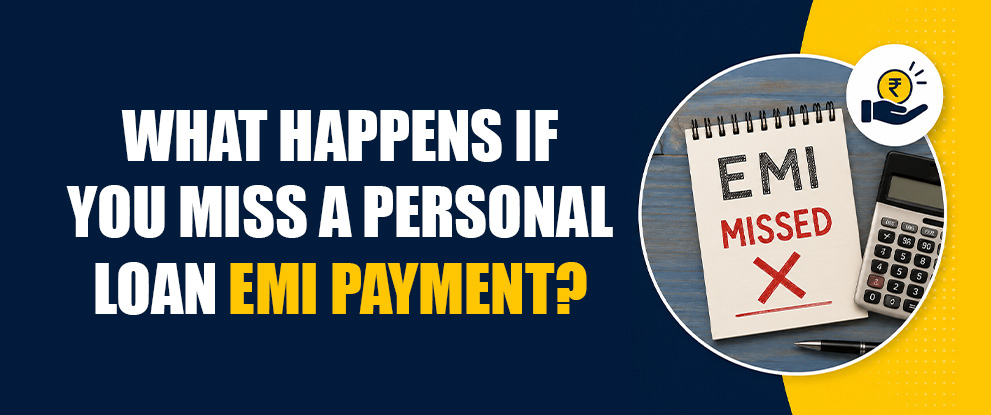
Most personal loans are repaid through an auto-debit mandate linked to a bank account. If the lender is unable to collect the EMI on the due date, the payment is marked as unsuccessful. This can happen due to insufficient funds, account restrictions, or technical issues. Once the EMI fails, the lender may:
Apply EMI bounce charges or late payment fees
Charge penal interest on the overdue amount
Send reminders through SMS, email, or phone calls
Request immediate payment of the missed instalment
The exact charges vary by lender and are usually outlined in the loan agreement.
Payment history is one of the most important factors in credit scoring. Missing an emergency personal loan EMI signals repayment risk to lenders and can negatively affect your credit profile.
Even a single missed personal loan EMI can reduce your credit score if the delay is reported to the credit bureaus. A lower credit score can make it more difficult to:
Qualify for future loans
Obtain credit cards
Receive favourable interest rates
Access higher borrowing limits
For this reason, timely EMI payments play an important role in maintaining long-term credit health.
A short delay does not automatically mean that your loan has entered default status. However, late fees and bounce charges may still apply, and repeated delays can create a pattern of irregular repayment behaviour that lenders may consider during future credit evaluations. The sooner the overdue EMI is cleared, the lower the likelihood of long-term consequences.
The consequences of a missed person loan EMI become more serious when the overdue amount remains unpaid for an extended period. The typical progression is as follows:
|
Delay period |
Possible consequences |
|
A few days |
Late fees, bounce charges, and payment reminders |
|
Up to 30 days |
Overdue account status and possible credit score impact |
|
30–90 days |
Continued penalties, collection follow-ups, and a stronger credit score impact |
|
More than 90 days |
A loan may be classified as a Non-Performing Asset (NPA), and recovery proceedings may begin |
Under RBI norms, a loan account can generally be classified as an NPA if payments remain overdue for more than 90 days.
Short-term personal loans are typically unsecured loans, meaning they are not backed by collateral. However, that does not mean lenders cannot pursue recovery. If multiple EMIs remain unpaid, the lender may:
Intensify collection efforts
Issue formal notices
Engage recovery agencies in accordance with applicable regulations
Initiate legal proceedings to recover the outstanding dues
The exact recovery process depends on the lender, loan agreement, and amount overdue.
Acting quickly can help minimise the impact of a missed payment. The following steps may help:
The shorter the delay, the lower the risk of penalties accumulating and affecting your credit profile.
If repayment difficulties are temporary, informing the lender early may help you understand available options and avoid unnecessary escalation.
Sometimes an EMI fails due to technical issues, expired mandates, or insufficient balance rather than an inability to repay. Identifying the cause can help prevent future occurrences.
Reviewing your credit report periodically can help you understand whether the missed payment has been reported and whether any corrections are required.
Simple planning measures can reduce the risk of missed payments. Some commonly used practices include:
Maintaining sufficient balance before the due date
Setting payment reminders
Tracking loan repayment schedules
Keeping emergency savings for unexpected expenses
Reviewing bank account mandates periodically
Consistent repayment habits not only help avoid penalties but also support a stronger credit profile over time.
A missed personal loan EMI can affect more than just your monthly budget, making timely repayments an important part of financial planning. Building an emergency cushion and monitoring repayment schedules can help avoid disruptions. For urgent funding requirements, an instant personal loan app like Loan112 offers personal loans of up to Rs. 5 lakh, with disbursals in as little as 10 minutes for eligible borrowers.


Apply online for instant emergency loans with quick approval, minimal paperwork, and fast disbursal—when you need funds the most.
Apply online for instant emergency personal loans with Loan112—fast approval, minimal documents, and quick disbursal in Gurgaon.

Looking for urgent cash in Hyderabad? Get instant short-term personal loans in Hyderabad with easy eligibility, fast approval, and online disbursal.
Instant emergency personal loans in Bangalore with a smooth online process, quick approval, and fast online disbursal for urgent financial needs.

Get instant short-term loans in Kolkata without CIBIL score checks, with easy online application, quick approval, and fast fund disbursal.
DEVMUNI LEASING & FINANCE LIMITED (RBI Reg. No.: 8-14.02719) is a Non-Banking Finance Company (NBFC) registered with the Reserve Bank of India (RBI). Loan112 is the brand name under which the company conducts its lending operations and specializes in providing quick and easy access to personal loans to meet customers' instant financial needs.


