In India, people often assume that borrowing money is just an added expense, but the tax effect on loan interest can actually work in your favour. While personal loans are primarily used for quick cash needs, they can also serve as effective tax-saving tools. In fact, personal loan disbursements rose 23% YoY in value during H1 FY26 and 35% YoY in Q2 FY26. Understanding the tax implications of personal loans is crucial for informed financial planning, which we discuss in this blog.
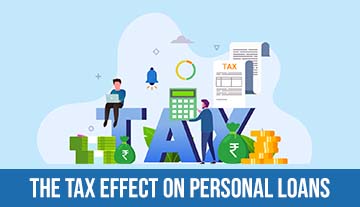
A personal loan is an unsecured loan, meaning you don’t need to pledge any asset as collateral. Banks and Non-Banking Financial Companies (NBFCs) disburse these loans for various purposes, from home renovation and education to business needs and vacation costs.
The principal amount received as a personal loan is not taxable income since it’s classified as a liability. However, for general consumption purposes like weddings, vacations, or gadget purchases, neither the principal repayment nor interest paid qualifies for tax deductions under the Income Tax Act, 1961.
The crucial factor is end-use. If you can demonstrate that your personal loan was used for specific tax-eligible purposes, you may claim substantial deductions.
Interest paid on personal loans used for business expansion or working capital can be claimed as a business expense under Section 37(1), with no upper limit. If you’re self-employed and borrow 5 lakh at 14% interest for equipment, the 70,000 annual interest reduces your taxable business income.
For house purchase or construction, you can claim up to 2,00,000 on interest for self-occupied property and up to 1,50,000 on principal under Section 80C. For home repairs, the limit is 30,000 annually. Let-out properties have no interest deduction cap.
Interest on personal loans used for higher education for yourself, spouse, or children is deductible under Section 80E with no upper limit for up to 8 years.
The choice between tax regimes significantly affects personal loan benefits in 2026. Income up to 12 lakhs is tax-free in the new regime with standard deduction and rebate, but most deductions are unavailable. Let’s take a look at the detailed comparison of tax benefits between the two regimes
to help you get an improved understanding of the impact on your ability to claim personal loan deductions and your overall tax liability:
|
Parameter |
Old tax regime |
New tax regime (Default from FY 2025–26) |
|
Personal loan - self-occupied property (interest) |
Up to 2,00,000 deduction under Section 24(b) |
Not available |
|
Personal loan - self-occupied property (principal) |
Up to 1,50,000 deduction under Section 80C |
Not available |
|
Personal loan – home repair |
Up to 30,000 deduction under Section 24(b) |
Not available |
|
Personal Loan – let-out property (interest) |
No limit on deduction under Section 24(b) |
Available – No limit |
|
Personal Loan – education |
Unlimited interest deduction under Section 80E (up to 8 years) |
Not available |
|
Personal Loan –business/professional use |
Unlimited deduction under Section 37(1) |
Unlimited deduction under Section 37(1) |
|
Tax slabs |
0%, 5%, 20%, 30% (higher rates) |
0%, 5%, 10%, 15%, 20%, 30% (lower rates) |
|
Standard deduction |
50,000 for salaried |
75,000 for salaried |
|
Regime selection |
Must opt in via Form 10-IEA |
Default regime (no action needed) |
As you evaluate these regimes, remember that smaller, short-term financial gaps don't always require a long-term tax strategy. An instant personal loan app like Loan112 can be a wise choice for these moments. Providing personal loans up to 1.5 lakh with disbursals in just 10 minutes, it offers the speed you need when you'd rather focus on your projects than on tax-regime calculations.
Beyond the primary tax benefits, here are three often-overlooked tax implications that every personal loan borrower should understand:
GST Impact: GST at 18% on all service-related fees charged by the lender, such as the processing fees, prepayment charges and foreclosure charges.
Loans from Friends/Family: Under section 56(2)(x) of the Income Tax Act, any sum of money received as a gift (without consideration) from a non-relative exceeding 50,000 in a financial year is taxable as income from other sources.
Investment Assets: If you use a personal loan to acquire a capital asset (like a house or land), the interest paid prior to the asset being put to use can be added to the cost of acquisition under Section 48. This reduces your taxable capital gains when you eventually sell the asset.
To successfully claim tax deductions on your personal loan, follow this simple approach:
Determine if loan usage qualifies
Obtain an interest certificate showing total interest paid in the financial year.
Verify applicable limits.
Choose between tax regimes
Subtract the eligible amount from ‘Income from House Property’ or ‘Gross Total Income’ as appropriate.
Personal loans in 2026 offer tax benefits only when used for specific purposes, business expansion, property purchase, or education. With the New Tax Regime as default, most personal loan deductions (except business-related) are unavailable, making regime choice essential for ensuring better tax effect on the loan. Careful documentation and professional tax advice are essential for maximising benefits while ensuring compliance.


Apply online for instant emergency loans with quick approval, minimal paperwork, and fast disbursal—when you need funds the most.
Apply online for instant emergency personal loans with Loan112—fast approval, minimal documents, and quick disbursal in Gurgaon.

Looking for urgent cash in Hyderabad? Get instant short-term personal loans in Hyderabad with easy eligibility, fast approval, and online disbursal.

Instant emergency personal loans in Bangalore with a smooth online process, quick approval, and fast online disbursal for urgent financial needs.

Get instant short-term loans in Kolkata without CIBIL score checks, with easy online application, quick approval, and fast fund disbursal.
DEVMUNI LEASING & FINANCE LIMITED (RBI Reg. No.: 8-14.02719) is a Non-Banking Finance Company (NBFC) registered with the Reserve Bank of India (RBI). Loan112 is the brand name under which the company conducts its lending operations and specializes in providing quick and easy access to personal loans to meet customers' instant financial needs.


