Borrowing has become a common part of personal finance in India, but repayment challenges are also increasing. Recent industry data shows that around 3.6% of personal loans in India were overdue by more than 90 days in 2025, showcasing the growing number of borrowers facing repayment stress.
When borrowers struggle to repay their dues, they often come across two terms: loan settlement and loan closure. Although both options bring a loan account to an end, they are very different in terms of repayment structure, lender reporting, and long-term financial impact. Understanding how settlement loans work compared to a properly closed loan can help borrowers make informed financial decisions and avoid unintended consequences in the future.
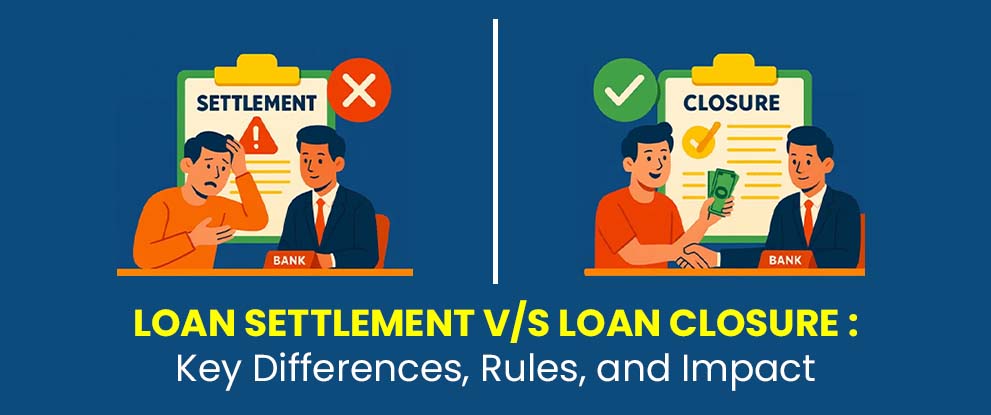
Loan settlement occurs when a borrower is unable to repay the full outstanding loan amount and negotiates with the lender to close the account by paying a reduced amount. This usually happens when prolonged financial difficulty makes regular EMI payments impossible.
In such cases, the lender may agree to accept a lump-sum payment that is lower than the total dues in order to recover at least part of the outstanding balance. In many settlement cases, lenders may recover around 40% to 80% of the outstanding loan amount, depending on the borrower’s financial situation and negotiation terms.
Once this negotiated payment is made, the lender marks the account as settled. While settlement loans can provide temporary financial relief, they may affect a borrower’s financial profile and future borrowing prospects.
Loan closure refers to the complete repayment of a loan as per the original terms agreed upon with the lender. This means the borrower has paid all EMIs, interest, and any applicable charges until the outstanding balance becomes zero.
After the final payment, the lender officially closes the account and issues a loan closure certificate or no-dues certificate. A properly closed loan generally reflects positively in financial records because it demonstrates consistent repayment behaviour and financial discipline.
Settlement loans can provide temporary relief during financial hardship, but they can significantly affect your financial record. When a loan is ‘settled’ instead of fully repaid, lenders report the account as settled rather than ‘closed’. This indicates that the borrower could not repay the loan as agreed.
As a result, the borrower’s credit score may drop significantly, often by 75 to 150 points, depending on the overall repayment history.
Additionally, the ‘settled’ remark can remain visible in the borrower’s credit report for up to seven years, which may affect eligibility for future loans, credit cards, or other financial products. This is where modern fintech proves invaluable; for example, the Loan112 instant personal loan app provides loans up to 1.5 lakh with disbursals in just 10 minutes. Having access to such rapid funding allows you to clear a high-pressure debt in full, ensuring your record stays ‘Closed’ and your future borrowing power remains intact.
Before opting for settlement loans, borrowers should understand a few important considerations:
Settlement is usually offered after defaults: Lenders generally consider settlement only when regular repayments have stopped for an extended period.
Negotiation is required: Borrowers often need to negotiate with the lender and provide proof of financial hardship.
Written agreement is essential: Always obtain a settlement letter that clearly mentions the final agreed amount and confirms that the remaining dues are waived.
Credit history impact: Even after payment, the loan will be marked as settled in financial records.
Future borrowing may become difficult: Lenders may treat past settlement as a sign of higher risk.
Although both processes end a loan account, the repayment structure, reporting method, and long-term financial implications differ significantly. The following points explain how loan closure and settlement loans vary in practical terms.
|
Feature |
Loan Closure |
Loan Settlement |
|
Repayment Amount |
The borrower repays 100% of the outstanding amount, including principal, interest, and applicable charges, according to the original agreement. |
The lender accepts a reduced lump-sum payment, typically a portion of the total outstanding amount, and waives the remaining balance. |
|
Status in Records |
The lender reports the account as ‘Closed’ to TransUnion CIBIL, confirming that the loan was repaid completely. |
The account is reported as ‘Settled’, which indicates that the borrower paid only a partial amount under a negotiated agreement. |
|
Impact on Borrowing Profile |
A closed account reflects consistent repayment behaviour and strengthens the borrower’s financial profile over time. |
Settlement loans may weaken the borrower’s profile because they indicate that the original repayment terms were not fulfilled. |
|
Lender Perception |
Lenders generally view borrowers with properly closed loans as financially disciplined and reliable. |
Borrowers with settled accounts may be assessed with greater caution because the lender recovered only part of the outstanding amount. |
|
Documentation Issued |
The lender provides a No Objection Certificate (NOC) or No Dues Certificate, confirming that all payments have been completed. |
The borrower receives a settlement letter that confirms the negotiated payment and the waiver of the remaining balance. |
|
Future Loan Eligibility |
Having several closed loans on record may support easier approvals and access to competitive interest rates. |
A settled status may make lenders more cautious, which could influence approval decisions or loan terms in future applications. |
|
Repayment Process |
The loan is cleared through regular EMIs until the end of the tenure or through full prepayment of the remaining balance. |
Settlement typically occurs after prolonged repayment difficulties, where the borrower negotiates a one-time payment to close the account. |
|
Financial Record Duration |
The closed status becomes part of the borrower’s positive financial history maintained by TransUnion CIBIL. |
The settled remark may remain visible in the financial record for several years, which can influence lender evaluations. |
In most cases, loan closure is financially healthier than loan settlement. Fully repaying the loan helps maintain a strong financial record and improves the chances of getting loans in the future.
Settlement loans, on the other hand, are typically considered only when borrowers genuinely cannot continue repayments and need a structured way to resolve their outstanding debt.
The choice between loan settlement and loan closure is a choice between short-term relief and long-term freedom. While opting for settlement loans might provide an immediate exit from debt pressure, it leaves a lasting mark on your credit history. Whenever possible, strive for a clean closure to ensure your financial future remains secure and your creditworthiness stays intact.


Apply online for instant emergency loans with quick approval, minimal paperwork, and fast disbursal—when you need funds the most.
Apply online for instant emergency personal loans with Loan112—fast approval, minimal documents, and quick disbursal in Gurgaon.

Looking for urgent cash in Hyderabad? Get instant short-term personal loans in Hyderabad with easy eligibility, fast approval, and online disbursal.

Instant emergency personal loans in Bangalore with a smooth online process, quick approval, and fast online disbursal for urgent financial needs.

Get instant short-term loans in Kolkata without CIBIL score checks, with easy online application, quick approval, and fast fund disbursal.
DEVMUNI LEASING & FINANCE LIMITED (RBI Reg. No.: 8-14.02719) is a Non-Banking Finance Company (NBFC) registered with the Reserve Bank of India (RBI). Loan112 is the brand name under which the company conducts its lending operations and specializes in providing quick and easy access to personal loans to meet customers' instant financial needs.


