In 2026, India’s economy is being affected not just by domestic policies but also by the ongoing Iran - Middle East war, which began in late February 2026 when the United States and Israel launched strikes on Iran. What started as a geopolitical crisis has quickly turned into one of the most serious global disruptions in energy markets, supply chains, and financial systems in decades.
While India is not a direct combatant, the economic impact of war is nevertheless visible across markets, corporate balance sheets, household wallets, and national policy priorities due to India’s deep integration with global trade and energy flows.
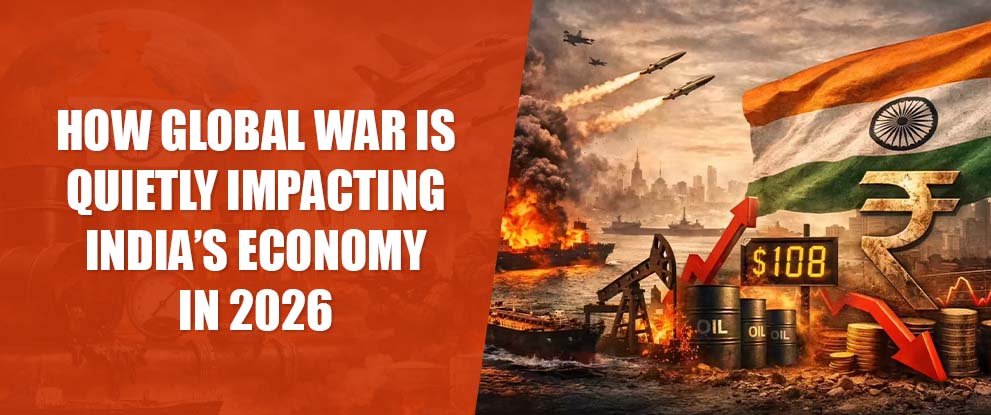
India relies heavily on oil and gas imports, with a significant portion of its petroleum. Conflict-related disruptions to shipping and energy production have led to spikes in crude prices, often exceeding $110–$120 per barrel, a level that hasn’t been seen consistently since the early 2010s.
Higher global oil prices feed directly into domestic fuel prices. For Indian consumers and producers, this translates to:
More expensive petrol, diesel, and LPG are increasing household transport and cooking fuel costs.
Higher logistics and manufacturing expenses feed into the prices of everyday goods.
A quicker pass through to inflation, challenging the Reserve Bank of India’s efforts to maintain price stability.
This channel's energy costs → transport → goods pricing is one of the clearest illustrations of the global conflict’s economic reach.
With geopolitical uncertainty, investors flock to safe-haven assets like the U.S. dollar. The Indian rupee fell sharply, hitting multi - year lows against the dollar in March 2026, pressured by:
Rising oil import costs, which increase India’s demand for dollars;
Foreign investor outflows from Indian markets.
Risk-off sentiment in emerging markets.
Currency weakness makes imports even more expensive, widening India’s current account deficit and adding inflation risk. Equity markets have also been volatile: benchmark indices such as the Sensex and Nifty 50 have seen sharp drops as crude prices rose and investor sentiment turned cautious.
In one warning scenario analysed by global brokerage Bernstein, continued conflict could see the Nifty fall below 19,000 and the rupee weaken further to 110 per dollar, showcasing the scale of market risk tied to geopolitical developments.
Modern supply chains link manufacturers and consumers worldwide. When conflict disrupts key routes or airspace closures, the effects are widespread:
Delays in cargo and freight increase shipping costs.
Critical component imports (e.g., for electronics and pharmaceuticals) slow down or become costlier.
Firms face production bottlenecks due to delayed or cancelled deliveries.
Global shipping volatility, partly driven by rerouting around conflict zones, increases lead times and transportation expenses. These costs often get passed on to consumers and corporations, raising the overall cost of doing business in India and globally.
India is one of the world’s largest recipients of remittances, largely due to millions of Indians working in GCC (Gulf Cooperation Council) countries. Diplomacy records and data indicate that more than 220,000 Indian nationals were repatriated from the Middle East due to conflict conditions within weeks of the war starting.
Reduced remittances weaken foreign exchange inflows and affect rural and urban purchasing power alike. Lower remittance flows can lead to less spending on education, healthcare, housing, and consumer goods, especially in regions dependent on income from overseas workers.
When do the Strait of Hormuz and related routes face conflict - related disruptions, global fertiliser supplies, especially nitrogen - based fertilisers like urea, are severely affected, since roughly one? A third of global fertiliser trade passes through this chokepoint. The war has driven fertiliser prices sharply higher, in some cases rising 30–40% or more as shipments are delayed and energy costs escalate, squeezing farmers’ budgets and feeding into food cost inflation.
India, a major exporter of staples like rice, wheat, and spices, also faces increased export costs due to elevated freight charges and logistical delays, reducing competitiveness. These combined pressures contribute to rising food inflation, showing how the economic impact of war extends from inputs to the consumer “farm-to-fork” chain.
India’s policymakers are actively responding to these pressures. The Cabinet Committee on Security (CCS) has acknowledged the significant impact of the West Asia conflict on both global markets and India’s domestic economy, underscoring targeted efforts to mitigate dependence on imports from volatile regions by diversifying supply sources, especially for chemicals, pharmaceuticals, and energy inputs.
The Reserve Bank of India (RBI) continues to navigate a fine balance, intervening in foreign exchange markets to temper volatility while also maintaining room to support growth and manage inflation expectations. Robust foreign exchange reserves (covering about 11 months of imports) offer a cushion, but persistent external pressures could still widen the current account deficit if import costs remain elevated.
Long-term strategic shifts also include investments in renewable energy, increased domestic production capacity for critical inputs, and deepening trade partnerships beyond traditional routes to reduce vulnerability to concentrated geopolitical risks.
The conflict’s impact extends beyond crude oil to natural gas markets as well. A recent analysis reported substantial disruption to global LNG supply, including sidelined shipments from major Middle Eastern producers like Qatar. Since LNG is an important feedstock for several Indian industries, including fertiliser and petrochemicals, this has pushed prices sharply higher. This surge in LNG prices has forced companies to switch to costlier fuel sources, squeezing margins and raising production costs for energy - intensive sectors.
Industries dependent on gas, such as chemical production and fertilisers, now grapple with rising input costs and reduced competitiveness, showcasing how the global war's impact on the economy affects sectors far beyond energy and logistics.
The global war's impact on the economy doesn’t stop at India’s borders. The United States has also felt economic spillovers, particularly through financial markets and energy price channels. Recent reports showed the global oil shock linked to the Iran-U.S. conflict has caused unusual volatility in U.S. Treasury markets, with liquidity stress and widened trading spreads emerging as investors reassessed risk and repositioned portfolios.
Such bond market stress reflects how geopolitical shocks can quickly translate into heightened financial risk even in economies like the U.S., which enjoys relative energy independence. Rising global inflation expectations tied to energy prices could also complicate the Federal Reserve’s policy decisions, potentially delaying interest rate adjustments to balance inflation with growth.
The ongoing Iran-Middle East conflict shows the global war impact on economy, affecting energy prices, trade, and food costs in India. Amid rising expenses, households may face short-term financial gaps, and using instant personal loan platforms like Loan112, which offers loans up to 1.5 Lakh with 10-minute disbursals, can help manage urgent needs efficiently.


Apply online for instant emergency loans with quick approval, minimal paperwork, and fast disbursal—when you need funds the most.

Apply online for instant emergency personal loans with Loan112—fast approval, minimal documents, and quick disbursal in Gurgaon.

Looking for urgent cash in Hyderabad? Get instant short-term personal loans in Hyderabad with easy eligibility, fast approval, and online disbursal.

Instant emergency personal loans in Bangalore with a smooth online process, quick approval, and fast online disbursal for urgent financial needs.
Get instant short-term loans in Kolkata without CIBIL score checks, with easy online application, quick approval, and fast fund disbursal.
DEVMUNI LEASING & FINANCE LIMITED (RBI Reg. No.: 8-14.02719) is a Non-Banking Finance Company (NBFC) registered with the Reserve Bank of India (RBI). Loan112 is the brand name under which the company conducts its lending operations and specializes in providing quick and easy access to personal loans to meet customers' instant financial needs.


