The Union Budget is often viewed through the lens of tax slabs and infrastructure, but for the millions of Indians balancing monthly budgets, one question reigns supreme: Will my EMIs go down? As the Finance Minister concluded the presentation for the 2026-27 fiscal year on 1st February, the Union Budget 2026 EMI impact became a central theme for retail borrowers. With the government managing a record borrowing plan while maintaining fiscal discipline, personal loan interest rates in India for 2026 are expected to remain stable but cautious.
In this blog, we discuss how the latest policy shifts, fiscal deficit targets, and the Reserve Bank of India’s (RBI) likely response will determine whether your bank sends you a ‘reduced interest rate’ notification this year.
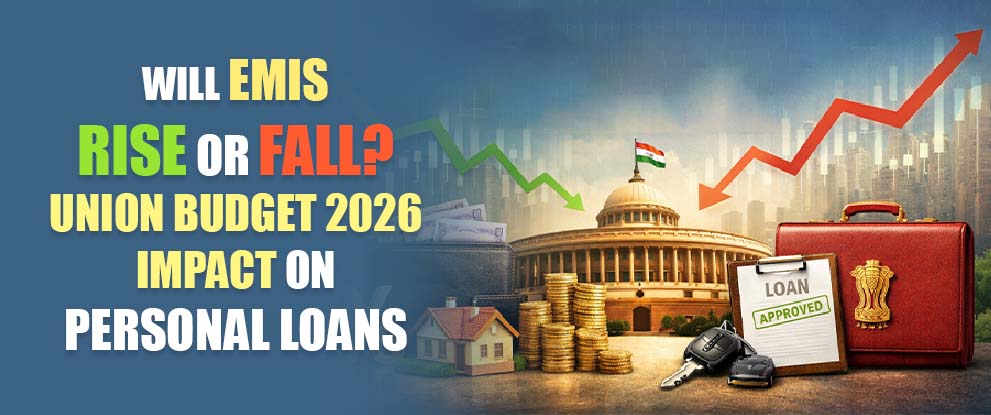
The most direct way a budget affects your loan is through the Fiscal Deficit. For 2026-27, the government has set a Fiscal Deficit target of 4.3%.
Why this matters for your EMI: When the government reduces its deficit, it signals to the market that it is borrowing responsibly. Lower government borrowing typically leaves more liquidity in the banking system for the common man, which can lead to a softening of interest rates.
However, there is a catch. The government also announced a gross market borrowing programme of Rs. 17.2 lakh crore, a record high. This massive supply of government bonds can sometimes push bond yields up. Since banks often use these yields as a benchmark for pricing their own loans, this could create a floor for interest rates, preventing them from falling as fast as borrowers might hope.
Currently, personal loan interest rates in India for 2026 range from 9.9% to 22%, depending on the lender and the borrower’s credit profile. The Budget’s focus on a 10% nominal GDP growth and controlled inflation provides the RBI with a cushion to cut the Repo Rate later in the year, potentially.
Most economists predict that while the February 2026 RBI meeting might see a status quo (no change), a 25 to 50 basis point (bps) cut is highly probable by the second or third quarter of 2026. If you have a floating-rate personal loan, this would directly translate to a lower EMI or a reduced loan tenure.
The Union Budget 2026 EMI influence is not just about the interest percentage; it’s also about your repayment capacity.
New Tax Regime Push: The budget continued to incentivise the New Tax Regime. For those with a taxable income up to ?12 lakh, the effective tax liability remains zero. This higher disposable income makes it easier for families to service their existing EMIs without feeling the pinch.
Digital Lending Shift: The budget emphasised further digital public infrastructure. For the borrower, this means lower processing fees and administrative costs as banks move toward complete paperless verification.
With the growing move towards digital borrowing, an instant personal loan app like Loan112 can be a wise choice for managing immediate gaps. Providing personal loans up to Rs. 1.5 lakh with disbursals in just 10 minutes, Loan112 utilises this new digital infrastructure to offer speed that traditional banking cycles often miss, regardless of broader budget shifts.
If you are planning to take a loan or are currently paying one off, here is how to handle the 2026 financial outlook:
|
Factor |
Expected Trend |
Action for Borrower |
|
Repo Rate |
Likely to drop by 0.25%–0.50% by Q3 2026 |
Consider waiting a few months before taking new big-ticket loans |
|
Fixed vs. Floating Rates |
Floating rates look more favourable |
Choose floating-rate loans to benefit from possible rate cuts |
|
Credit Score |
Lending norms are stricter in 2026 |
Keep your credit score above 750 to access lower interest rates |
|
Processing Fees |
Gradually declining due to digital KYC |
Negotiate fees or opt for zero processing fee offers |
So, will your EMIs fall? The short answer is: Not immediately, but likely by mid-2026.
The Budget has laid a disciplined foundation, but the record-high borrowing means banks will be slow to pass on benefits until the RBI officially moves the needle. For those with high-interest personal loans, 2026 might be the perfect year to consider a balance transfer. With many fintechs and banks competing for good borrowers, you could switch to a lower-interest regime even before the systemic rates drop.
The Union Budget 2026 EMI impact is one of cautious optimism. While the government isn't handing out direct subsidies for personal loans, its focus on low inflation and fiscal consolidation is creating the perfect environment for a rate-cut cycle. Keep a close eye on the RBI’s upcoming policy announcements; your monthly budget might just get a little more breathing room soon.


Apply online for instant emergency loans with quick approval, minimal paperwork, and fast disbursal—when you need funds the most.
Apply online for instant emergency personal loans with Loan112—fast approval, minimal documents, and quick disbursal in Gurgaon.

Looking for urgent cash in Hyderabad? Get instant short-term personal loans in Hyderabad with easy eligibility, fast approval, and online disbursal.
Instant emergency personal loans in Bangalore with a smooth online process, quick approval, and fast online disbursal for urgent financial needs.
Get instant short-term loans in Kolkata without CIBIL score checks, with easy online application, quick approval, and fast fund disbursal.
DEVMUNI LEASING & FINANCE LIMITED (RBI Reg. No.: 8-14.02719) is a Non-Banking Finance Company (NBFC) registered with the Reserve Bank of India (RBI). Loan112 is the brand name under which the company conducts its lending operations and specializes in providing quick and easy access to personal loans to meet customers' instant financial needs.


