When you take a personal loan, you might notice that your very first EMI is slightly higher than the others, or that there is a small additional charge labelled as Broken Period Interest (BPI). For many borrowers in 2026, this remains confusing, especially when loan statements don’t clearly explain where the extra amount comes from.
In fact, studies show that nearly 35% of borrowers in India have delayed at least one EMI in the past two years, often due to misunderstandings around repayment structures and interest components.
This is exactly where terms like broken period interest start to feel unclear or even misleading.
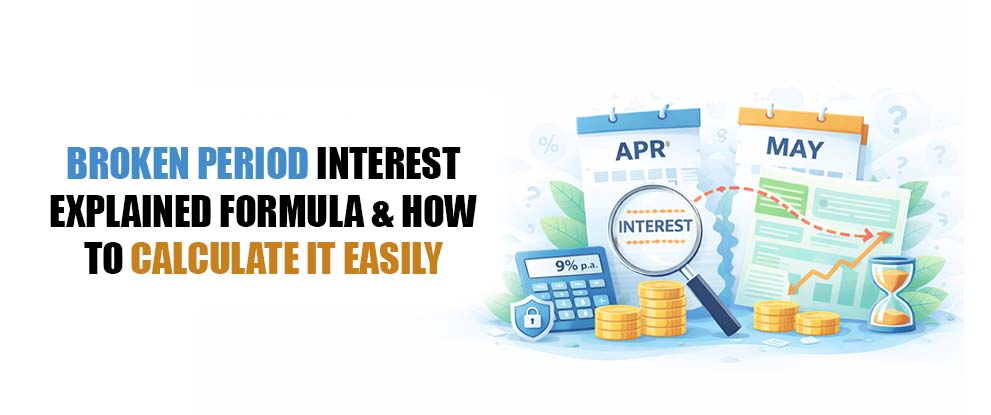
Broken period interest refers to the interest charged for the time gap between the loan disbursement date and the start of your first EMI (Equated Monthly Instalment).
In simple terms, the moment a lender disburses the loan, interest starts accruing, even if your EMI cycle hasn’t begun yet. This extra period is called the broken period, and the interest charged for it is known as BPI (Broken Period Interest). This typically happens when:
So, you end up paying interest for those initial days before your first EMI kicks in.
Banks follow fixed EMI cycles (like the 1st or 5th of every month). If your loan is disbursed mid-cycle, there’s a gap period where:
To cover this gap, lenders charge interest on broken periods. This ensures that interest is calculated accurately for the exact number of days the funds were used.
The BPI calculation is based on a simple daily interest formula. Banks calculate interest proportionately for the exact number of days in the broken period.
BPI = (Principal × Interest Rate × Number of Days) ÷ 365
Where:
Taking an example, suppose you take a loan of 5,00,000 at 10% annual interest, and your EMI starts 20 days after disbursement.
BPI = (500000 × 0.10 × 20) ÷ 365
BPI = 1000000 ÷ 365
BPI = 2,740
This means you will pay 2,740 as broken period interest. This amount may either be paid upfront or adjusted in your loan, depending on your lender’s policy.
Several factors influence how much broken period interest you need to pay. Understanding these can help you estimate and manage your costs better:
Being aware of these factors helps you make informed borrowing decisions and avoid unexpected charges at the beginning of your loan tenure.
You can reduce your BPI calculation amount with a few smart decisions while planning your loan. Here’s a simple table to help you understand practical ways to minimise this cost:
|
Tip |
How It Helps |
|
Choose an early-month disbursement |
Reduces the number of days in the broken period |
|
Align the EMI date with the disbursement |
Minimises or eliminates the gap period |
|
Opt for an immediate EMI start |
Some lenders allow EMI to begin quickly |
|
Compare lender policies |
Different banks may calculate BPI differently |
|
Plan loan timing in advance |
Strategic timing can reduce unnecessary interest |
|
Ask about pre-EMI options |
Helps manage how the interest is charged |
To sum up, understanding broken period interest helps you avoid confusion around your first EMI and plan repayments better. By timing your loan smartly and choosing lenders carefully, you can minimise extra costs. Opting for instant personal loan apps like Loan112, which offer loans up to 1.5 lakh with quick 10-minute disbursals and clear repayment structures, can also make managing BPI more transparent and convenient.


Apply online for instant emergency loans with quick approval, minimal paperwork, and fast disbursal—when you need funds the most.
Apply online for instant emergency personal loans with Loan112—fast approval, minimal documents, and quick disbursal in Gurgaon.

Looking for urgent cash in Hyderabad? Get instant short-term personal loans in Hyderabad with easy eligibility, fast approval, and online disbursal.
Instant emergency personal loans in Bangalore with a smooth online process, quick approval, and fast online disbursal for urgent financial needs.
Get instant short-term loans in Kolkata without CIBIL score checks, with easy online application, quick approval, and fast fund disbursal.
DEVMUNI LEASING & FINANCE LIMITED (RBI Reg. No.: 8-14.02719) is a Non-Banking Finance Company (NBFC) registered with the Reserve Bank of India (RBI). Loan112 is the brand name under which the company conducts its lending operations and specializes in providing quick and easy access to personal loans to meet customers' instant financial needs.


