Managing money today feels more difficult than before, even when income increases. In India, retail inflation stood around 3.21% in February 2026, but many people feel their personal expenses are rising much faster than that.
This gap between income and spending is often driven by lifestyle inflation. Along with the cost of living increase in 2026, changing habits and spending patterns are quietly pushing expenses higher. Let’s understand why this happens and what it means for your finances.
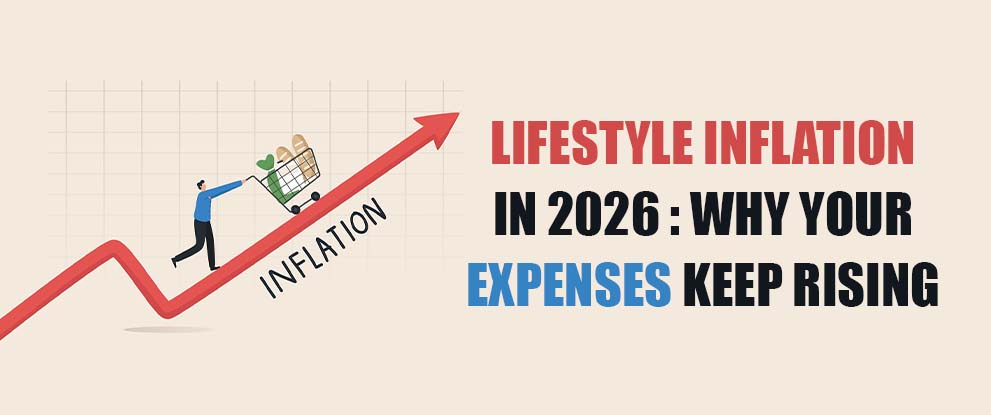
Lifestyle inflation refers to the tendency to increase spending as income grows. Instead of saving more after a salary hike, people often upgrade their lifestyle. This can include:
Over time, these small upgrades become regular expenses, making it difficult to save even when earnings increase.
The rise in expenses is not just about personal choices. It is also linked to broader economic factors and changing consumption habits.
One of the biggest reasons behind increasing expenses is inflation. Even when inflation seems moderate on paper, essential categories like food, rent, and services continue to rise steadily.
Housing costs, in particular, are becoming more significant, as they form a major part of urban spending. Fuel prices and global factors also impact transportation and daily essentials.
As income increases, spending patterns also change. People tend to upgrade their lifestyle gradually without noticing.
These changes may seem small individually, but together they significantly increase monthly expenses.
Digital payments and credit options have made spending easier than ever. Features like Buy Now Pay Later (BNPL), credit cards, and instant loans allow users to spend without immediate financial pressure.
This often leads to higher consumption, as payments are delayed but expenses continue to accumulate.
Another key reason why expenses are increasing is the rise of subscription-based services.
Individually, these may seem affordable, but combined, they add a fixed cost to your monthly budget.
Social media and online platforms also play a major role in lifestyle inflation. Constant exposure to upgraded lifestyles encourages people to spend more.
Whether it’s travel, gadgets, or fashion, there is a growing pressure to match certain standards, leading to increased discretionary spending
This increase becomes clearer when you compare how everyday expenses have changed over time.
To better understand why expenses are increasing, it helps to compare how spending patterns have changed over time. Even with moderate inflation, everyday categories like rent, food, and lifestyle spending have seen noticeable increases.
For example, the average monthly cost for a single person in India is now around ?27,000 excluding rent, while metro city costs can go significantly higher depending on lifestyle. Here’s a simple comparison:
|
Expense Category |
Earlier Spending (Approx) |
Current Spending (Approx) |
|
Rent |
10,000 – 15,000 |
20,000 – 40,000 |
|
Groceries |
3,000 – 5,000 |
6,000 – 10,000 |
|
Eating Out |
1,000 – 2,000 |
3,000 – 6,000 |
|
Subscriptions |
200 – 500 |
1,000 – 2,500 |
|
Transport |
2,000 – 3,000 |
4,000 – 8,000 |
This clearly shows that the cost of living increase in 2026 is not limited to one category; it affects multiple areas simultaneously.
At the same time, lifestyle inflation adds to this pressure by increasing discretionary spending. When both factors combine, overall expenses rise much faster than expected.
In situations where expenses suddenly increase or urgent financial needs arise, many users now rely on digital lending solutions. For example, using an instant personal loan app like Loan112, which offers loans up to 1.5 Lakh with 10-minute disbursals, can help manage urgent needs efficiently.
This displays how financial behaviour is evolving alongside rising costs, with users looking for quicker and more flexible ways to manage their expenses.
Lifestyle inflation often happens gradually, making it difficult to notice. Some common signs include:
Recognising these patterns is the first step toward better financial control.
Lifestyle inflation can have a long-term impact on financial stability if not managed properly.
Over time, this can create a cycle where higher income does not translate into better financial security.
Breaking the cycle requires intentionality. Here are three crisp strategies to stay ahead:
Apply the 50-30-20 Rule: Allocate 50% of your income to needs, 30% to wants, and 20% strictly to savings. When you get a raise, maintain these ratios or, better yet, increase the savings percentage.
Automate Your Future: Set up an automatic SIP that triggers the day after your salary hits. If the money isn't in your account, you can't spend it on a lifestyle upgrade.
The 30-Day Pause: Before committing to a new recurring expense like a subscription or a higher-rent flat, wait 30 days. Most needs turn out to be temporary impulses.
Balancing spending and saving helps maintain financial stability even as income grows.
Lifestyle inflation is a quiet thief of wealth. While a cost of living increase in 2026 is partially driven by macroeconomic shifts, the biggest driver is often our own desire to upgrade. By recognising that a higher income is an opportunity for financial security rather than just a better car, you can ensure that your wealth grows faster than your wardrobe.


Apply online for instant emergency loans with quick approval, minimal paperwork, and fast disbursal—when you need funds the most.
Apply online for instant emergency personal loans with Loan112—fast approval, minimal documents, and quick disbursal in Gurgaon.

Looking for urgent cash in Hyderabad? Get instant short-term personal loans in Hyderabad with easy eligibility, fast approval, and online disbursal.
Instant emergency personal loans in Bangalore with a smooth online process, quick approval, and fast online disbursal for urgent financial needs.
Get instant short-term loans in Kolkata without CIBIL score checks, with easy online application, quick approval, and fast fund disbursal.
DEVMUNI LEASING & FINANCE LIMITED (RBI Reg. No.: 8-14.02719) is a Non-Banking Finance Company (NBFC) registered with the Reserve Bank of India (RBI). Loan112 is the brand name under which the company conducts its lending operations and specializes in providing quick and easy access to personal loans to meet customers' instant financial needs.


